Fujifilm Finepix S9100 Digital Camera Action Shots Review
Quick Review
Fuji FinePix S3100 Digital Camera
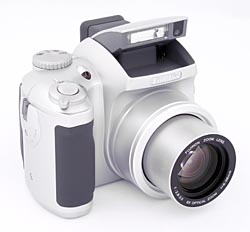 | Camera QuickLook | |
| Review Engagement | 11/15/04 | |
| User Level | Novice - Amateur | |
| Product Uses | Family / Travel / Special Events | |
| Digicam Design | Bespeak and Shoot | |
| Flick Quality | Good, 4.0-megapixel CCD | |
| Print Sizes | up to 11x14, 8x10 with some cropping | |
| Availability | Now | |
| Suggested Retail Price (At introduction) | $299.99 | |
Introduction
Fujifilm produces a wide range of digicam models, from blank-basic entry-level models upwards to and including a high-end digital SLR. To my listen though, their greatest success has been in creating good-quality midrange cameras that sell at very competitive prices, and the new Fuji FinePix S3100 is a expert case of that trend. A couple of years back, Fuji brought long-zoom digicams down to affordable cost levels with their FinePix 2800 and 3800 models. Now, the Fuji S3100 advances the cause even further, with a 4.0 megapixel CCD, a 6x optical zoom lens, and a host of exposure features. While it still sports a super-easy fully automatic mode, the Fuji 3100 goes beyond bones "point & shoot" adequacy with an Aperture Priority fashion and handful of adjustable exposure options. (Yet, the Fuji S3100 drops the audio recording capability and the Continuous Shooting modes seen in some of its predecessors, presumably to proceed the cost low in the face up of its college resolution.) All in all, the Fuji 3100 offers true long-zoom capability at a surprisingly affordable price.
Photographic camera Overview
Featuring a miniaturized, "SLR-mode" body design reminiscent of the FinePix 2800 and 3800 digicams, the Fuji FinePix S3100 offers the same great 6x optical zoom lens, though now complemented by a full four-megapixel CCD. To suit the camera's long zoom lens, the Fuji S3100'south trunk is a piddling mesomorphic, simply still compact compared to many long-zoom digicams. Very portable and lightweight, the S3100 will definitely be handy for impromptu outings and social gatherings. An included lens embrace/accessory lens adapter ring provides protection and doesn't add too much to the bulk, so users would exercise well to continue it fastened to protect the projecting lens from impact harm. Conveniently, the lens cap fits on both the lens and the lens with adapter ring. Too large for a standard shirt pocket either way, the Fuji 3100 should fit into larger glaze pockets and purses, and comes with a shoulder strap to make carrying information technology easier. Measuring 3.ix ten 3.0 x 2.7 inches (100 x 77 x 69 millimeters), the S3100 weighs 14.5 ounces (410 grams) with batteries and xD-Picture show Card, and fits well in i manus. A substantial handgrip provides a very business firm hold, nicely balancing out the weight of the lens barrel. The Fuji 3100's four.0-megapixel CCD delivers clear, sharp images as big equally ii,272 ten one,704 pixels, suitable for press as large as 11x14 inches with neat detail, or 8x10 inches with some cropping. (A lower resolution is likewise available for more than email-friendly file sizes.)
The Fuji S3100's Fujinon 6x, 6-36mm lens is the equivalent of a 39-234mm zoom on a 35mm photographic camera, representing a focal length range from moderate wide-bending to pretty substantial telephoto. A small, plastic lens cap protects the lens when not in use, and tethers to the photographic camera so you don't accept to worry about losing it. The telescoping lens extends most an inch from the camera when powered on, and promptly retracts when the camera is shut off. Apertures range from f/2.8 to f/8, and tin be manually gear up through the Record menu (in Manual way only). Focus remains under automatic command at all times, with a focal range from 2.half-dozen feet (0.8 meters) to infinity in normal mode, and from three.9 to 31.5 inches (10 to fourscore centimeters) in Macro fashion. In add-on to the 6x optical zoom, the S3100 besides offers as much as 3.4x digital enlargement, depending on the paradigm size selected. However, I ever bespeak out hither that digital zoom compromises image quality in that information technology just enlarges the center pixels of the CCD, resulting in less particular and higher image noise. Packaged with the Fuji S3100 is a lens adapter band, which screws into filter threads on the inside lip of the lens barrel. The ring protects the lens when it'due south extended and accommodates Fuji's wide angle, telephoto, and macro lens adapters, which extend the camera'southward zoom capabilities. The S3100 offers both a TTL electronic optical viewfinder (EVF) and a 1.5-inch, baggy silicon color LCD monitor. The viewfinder brandish switches between the EVF and LCD monitor via a button on the rear panel, which means that the complete display is bachelor on the EVF, including the settings menus. The viewfinder's information display reports diverse camera settings with a central AF target, and an optional framing guide display divides the epitome into thirds horizontally and vertically for more accurate framing.
Though the camera offers an Automatic and what is called a Manual exposure mode, exposure control is mainly automated, even in the "Transmission" mode. The Manner dial on top of the camera puts the camera into Manual, Scene, Machine, or Movie modes. Auto mode determines the entire exposure automatically, with the user able to adjust the zoom, wink mode, and image size and quality settings just. Transmission exposure mode expands user options to include white balance, exposure compensation, sharpness, flash power and discontinuity settings. Shutter speeds range from one/1,500 to two seconds, merely are not reported on the LCD brandish. The Discontinuity Priority selection under the settings menu offers iii apertures and an Machine setting, just this style requires some fiddling to get to. The Fuji 3100 uses a 64-zone metering system to determine exposure, placing the greatest emphasis on the center portion of the image surface area. Calorie-free sensitivity is nominally rated equally equivalent to ISO 100, and is not adaptable. However, the transmission states that the sensitivity will be automatically adjusted from 64 to 250 ISO equivalents as the shooting conditions dictate. When shooting in Manual exposure mode, exposure compensation is adjustable from -2.i to +one.five exposure equivalents (EV) in one-3rd-footstep increments. White Balance offers seven settings, including Auto, Daylight, Shade, Daylight Fluorescent, Warm White Fluorescent, Cool White Fluorescent, and Incandescent. The S3100'southward Scene mode offers 4 preset "scenes" for shooting in potentially tricky situations, and includes Portrait, Landscape, Sport, and Night Scene modes.
The Fuji FinePix S3100'due south built-in, pop-upwardly flash operates in one of six modes, which include Automobile, Cherry-Center Reduction, Forced, Suppressed, Slow Synchro, and Tiresome Synchro with Red-Eye Reduction modes. Through the settings menu, flash power is adjustable from -0.six to +0.half-dozen EV values in one-3rd-step increments. For self-portraits or those times when pressing the Shutter push might effect in photographic camera movement, the S3100 features a Self-Timer that delays the shutter release until 10 seconds afterwards the Shutter push is fully pressed. The FinePix S3100 can also capture movies without sound for a maximum of 240 seconds at its smaller resolution setting or lx seconds at the higher resolution, while in Movie capture mode. Movie files are saved in the Motility JPEG format, at either 320 10 240 or 160 x 120 pixels. Interestingly, Fuji dropped the sound recording capability establish on the previous 2800 and 3800 models, as well as a Continuous Shooting mode choice for capturing a rapid succession of images.
Images captured by the Fuji S3100 are saved to xD-Picture Cards. A 16MB bill of fare comes with the camera. In improver to the 2,272 x one,704-pixel resolution size, the S3100 besides offers one,600 10 1,200; ane,280 x 960; and 640 x 480-pixel resolutions. Two JPEG compression ratios are available, including Fine and Normal. The Playback card offers DPOF (Digital Print Order Format) settings for printing images on a compatible device. A USB cable and software CD accompany the photographic camera, allowing for loftier-speed connection to a computer. The software CD contains Fuji's FinePix Viewer software, which organizes and displays downloaded images, and provides printing and pocket-size editing capabilities.
The Fuji 3100 utilizes four AA batteries for power, and a fix of alkaline cells accompanies the camera. As e'er, I strongly recommend purchasing a couple of sets of loftier-chapters NiMH batteries and a proficient charger, and keeping a spare set of batteries charged at all times. Click here to read my "battery shootout" folio to meet which batteries currently on the market are best, or here for my review of the Maha C-204F charger, my longtime favorite. An AC adapter is as well a separate accessory, just helpful for saving bombardment power while reviewing and downloading images or when using the S3100 every bit a webcam. Unless yous're taking advantage of the camera's webcam capability though, rechargeable batteries would eliminate the need for the AC adapter.
With its compact and lightweight body, the convenience of full automated and partial manual exposure control, 4.0-megapixel CCD, and impressive 6x zoom lens, the S3100 is a skillful choice for consumers looking for a portable, affordable, easy to utilize digicam that takes good pictures. The S3100 offers a basic level of exposure control when y'all want information technology, some preset shooting modes for common catchy situations, and a Movie way for capturing quick $.25 of activity. Given the aggressive "street" prices the S3100 is selling at, it'southward one of the better bargains in the digicam market today.
Basic Features
- iv.0-megapixel foursquare-pixel CCD delivering imageS as large as 2,272 10 ane,704 pixels.
- 6x, 6-36mm lens (equivalent to a 39-234mm zoom on a 35mm photographic camera).
- Digital enlargement to iii.4x, depending on prototype resolution.
- 1.five-inch colour LCD monitor.
- Electronic optical viewfinder.
- Full automatic and partial manual exposure control.
- Shutter speeds range from i/1,500 to two seconds.
- Adjustable apertures from f/two.8 to f/viii.
- Sensitivity equivalent to ISO 100, though automatically set up from 64 to 250 depending on atmospheric condition.
- Born, pop-up wink with vi modes and variable intensity.
- Images saved in JPEG format to xD-Moving picture Carte du jour (16-megabyte card included).
- Power from four AA batteries or Air conditioning adapter (separate accessory).
- Interface software compatible with both PC and Mac platforms.
Special Features
- Picture mode (without audio) and Phonation Captioning part.
- Scene mode with four preset "scenes."
- 10-2d Self-Timer for delayed shutter release.
- White remainder (color) adjustment with 7 modes.
- Sharpness adjustment.
- DPOF (Digital Print Gild Format) compatibility.
- USB cable for connectedness to a computer (driver software included).
Recommendation
The Fuji FinePix S3100 offers excellent value and a proficient feature prepare for photographers interested in more telephoto adequacy than yous usually notice in zoom-equipped digicams. Its 6x zoom lens gets you twice as close to distant objects as the typical 3x zoom you find on most digicams, while Fuji's reputation for colour expertise ensures bright, vibrant colors. The S3100 would work well equally an all-around everyday camera, every bit well equally for shooting afar landscapes or wild fauna, and is portable enough to travel with yous. All in all, a nice, easy-to-use camera with a long zoom at a very affordable price.
Design
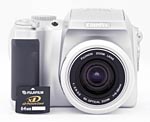 Small, lightweight, and comfortable in the hand, the Fuji FinePix S3100 adds to Fuji'due south growing line of very portable digicams. Building on the previous designs of the 3800 and 2800 Zoom models, the S3100 features an all-argent plastic body with charcoal accents on the handgrip areas. The S3100 hands fits into one paw, but is a trivial likewise chubby for nearly shirt pockets. Nevertheless, the Fuji S3100 could hands find its mode into larger coat pockets and purses, and the accompanying cervix/shoulder strap is a convenient carrying choice. Measuring 3.9 x three.0 10 2.7 inches (100 x 77 ten 69 millimeters), the photographic camera's all-plastic trunk keeps it fairly lightweight at just 14.5 ounces (410 grams) with batteries and xD-Picture Bill of fare. The S3100's argent exterior is very curvy, with smoothly sculpted protrusions for the handgrip and optical viewfinder mechanism. Camera controls are somewhat sparse, as most features are automatically controlled by the camera. This keeps the user interface uncluttered and clean, as well every bit simple to operate, just doesn't present the sophisticated exposure controls "enthusiasts" look for.
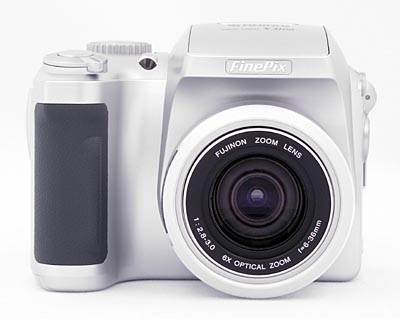
The front end of the Fuji 3100 is sleek and stylish, with shiny silver highlights on a matte silver body. The lens barrel protrudes from the camera front about an inch or so, and features the same matte silver finish as the rest of the photographic camera body. When the camera is powered on, the lens telescopes another inch from the camera trunk. A plastic lens cap protects the lens from scratches when not in utilise, and tethers to the photographic camera body to prevent it from beingness lost. Just inside the lip of the lens butt, a prepare of plastic filter threads host the lens adapter band that comes with the photographic camera. The lens shares the front panel with the self-timer LED (the minor, red LED between the Shutter button and popular-up flash). With the pop-upwards flash released, the flash itself is visible, as well as the tiny flash sensor. The beefy handgrip on the left side of the front end panel ensures a secure hold on the photographic camera, and is beefy enough to be useful without detracting from the camera's portable size.
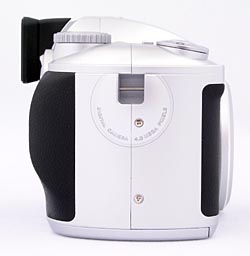
The correct side of the camera (viewed looking from the rear) is pretty empty, showing only a neck strap attachment eyelet.
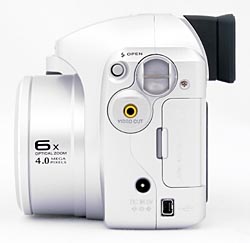
The DC In, USB, and Video Out connection jacks are on the reverse side of the camera, and lack any protective covering. I by and large similar to see some type of covering over these terminals, every bit dust and clay can easily find their manner into these pocket-size openings, especially on a very portable photographic camera such as this one. Also on this side of the photographic camera is the second cervix strap zipper eyelet, mechanical pop-upward wink release push button, and xD-Picture Card slot. The card slot is protected past a hinged, plastic door, which snaps firmly into identify. When this door is opened, power is cut to the camera, and the camera must be switched off and back on again to resume use.
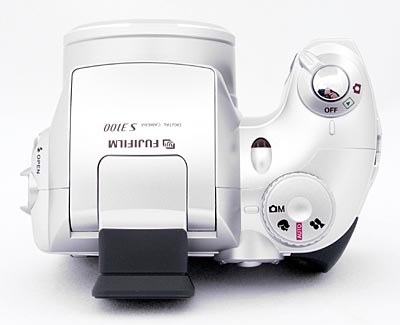
The Fuji S3100'due south meridian console features the Exposure Way dial, Shutter button, Ability/Mode dial, and pop-up flash.
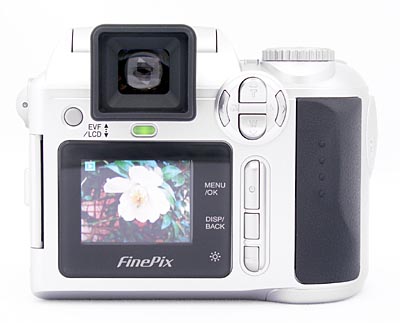
The remaining camera controls are on the back panel, along with the LCD monitor and EVF viewfinder eyepiece. Positioned to the right are the zoom controls and arrow buttons (arranged as a four-way arrow pad), and below this are the Bill of fare/OK, Brandish/Dorsum, and Depression-Light Viewfinder buttons. The correct and left arrow keys also control flash mode and macro mode, respectively. A sculpted thumb residual on the right side of the back console facilitates a tight grip on the camera, reinforced by the practiced manus grip on the front. Beneath the EVF eyepiece is a small LED, which reports the camera'due south current status (such equally when focus is fix, wink is charging, etc.), and the EVF/LCD push button.
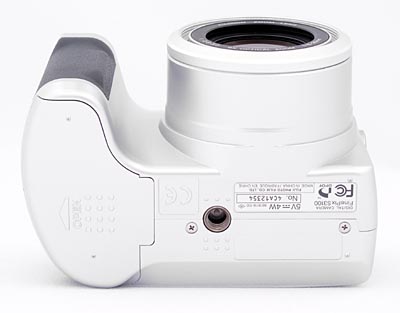
The Fuji 3100's bottom panel is nice and flat, though a series of raised bumps gives your fingers something to grip when opening the battery compartment embrace. This sliding cover protects the battery compartment, and moves outward (toward the side of the camera) before opening on a swivel to reveal the compartment. This is a great pattern for making the best utilize of space on the camera torso, simply bad for tripod work because you take to dismount the camera from the tripod to change batteries. I doubtable this won't be much of an issue for users of this camera all the same, every bit its designers were clearly intending it for on-the-go apply, not studio shooting. The tripod mountain features metal threads (kudos for that) and is slightly off-center from the lens. The off-center mount is a fiddling bad-mannered for shooting panorama photos (a fairly arcane practice, I suspect), just the position places information technology close to the camera'southward middle of balance, increasing stability and reducing strain on the tripod threads.
Camera Operation
With only a few controls, the Fuji FinePix S3100'due south user interface is straightforward. Exposure mode, flash, macro manner, and zoom all feature external controls. Settings similar exposure compensation and white balance are adjusted through the (as well elementary) LCD menu. Considering the S3100 operates mainly under automatic control, the user demand only worry about a few adjustments. Navigating the LCD menu arrangement is no problem, every bit there are simply a few options for the Record menu, the options depending on whether the camera is in Auto or Manual mode. The Setup menu is accessed as an selection on the Record and Playback menus. The camera'due south small size and few controls also make it easy to operate one-handed. All things considered, experienced digicam users may non even need to read the manual to operate the FinePix S3100.
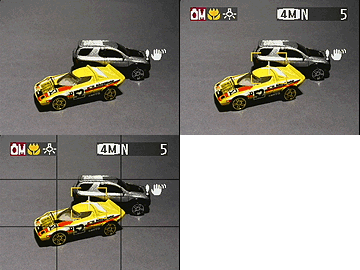 Record Display: In whatsoever shooting mode, the EVF and LCD monitors show a concise information readout by default. An outline box and crosshair point that the AF and exposure metering are determined from the centre of the frame. Also displayed is the exposure way, resolution, quality, and number of available images. Photographic camera settings such as flash mode, EV, etc. are also displayed if enabled. Pressing the Brandish push once enables a fine black framing filigree in improver to the information display, which divides the epitome area into thirds horizontally and vertically. (Grids like this are handy for lining up buildings and other objects.) A 2nd press of the Display push cancels both information and framing overlays, while a third printing returns to the default information display.
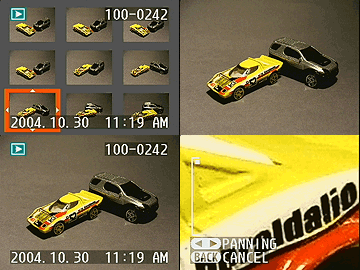 Playback Display: In Playback mode, the main display shows the captured image and a small playback symbol, while the date and time of capture and the file number appear for merely a few seconds as you curl to each new image. Pressing the Display button removes the icon and disables the momentary information display, showing the image just. A third press calls up the index display mode, which displays images on the memory card every bit tiny thumbnails, nine at a time, and also shows the date and fourth dimension of capture and file number of the currently highlighted image for a few seconds.
External Controls

Shutter Button: Located on tiptop of the camera, this push sets focus and exposure when pressed halfway. A full printing fires the shutter.
Power / Mode Punch: Surrounding the Shutter button on the top panel, this dial selects the camera'due south operating mode. Three choices are available:
- Record: Sets upward the photographic camera for recording all the same images.
- Playback: Allows the user to review captured images, delete them, zoom in on them, or set them upward for printing.
- Off: Shuts off the camera, signaling the lens to retract.

Exposure Mode Punch: Next to the pop-up flash compartment on the superlative panel, this dial controls the primary exposure style. Choices are:
- Manual: Offers partial transmission control over exposure, with Discontinuity Priority, White Balance, and Exposure Compensation adjustments available. Shutter speed remains under full automatic control. Options for setting Sharpness and adjusting flash power are also only available in Manual mode.
- Scene: Accesses the camera's four scene shooting modes (Portrait, Landscape, Sport, and Night Portrait).
- Machine: Places the camera under full automated exposure control. The user can adjust zoom, flash manner, and image size and quality settings.
- Film: Allows the camera to record moving images without sound.
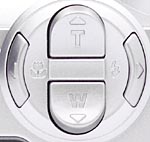
Zoom Rocker Control: In the top right corner of the back console, this zoom control with discrete "T" and "Westward" buttons is flanked past two arrow keys. In Tape mode, these buttons control the optical and digital zoom, and doubles as the upwards and down arrow keys when navigating the LCD menu system. In Playback style, the up and downward button controls digital enlargement of captured images. Once playback zoom is activated, pressing the left or right arrow cardinal switches the action of these buttons to control panning inside the enlarged prototype. Striking the Disp/Back push returns these buttons to controlling the playback zoom level.
Right and Left Arrow Buttons: Located on either side of the Zoom Rocker button, these buttons navigate left and right through settings menus. In Record manner, the left button accesses the Macro shooting mode, while the right button controls the flash style. In playback mode, these buttons switch from enlargement to panning mode. Once you're in panning mode, these buttons scroll left and right inside the enlarged paradigm.

EVF/LCD Button: Tucked away on the left side of the EVF eyepiece, this button alternates the viewfinder brandish between the eye-level viewfinder and the rear-panel LCD monitor.

Menu / OK Button: The top button in a serial of slim buttons lining the right side of the LCD monitor, the Menu / OK push activates the settings bill of fare in any mode. This push too serves as the OK to confirm menu selections.

Display / Dorsum Button: Directly below the Carte du jour / OK push button, this push backs out of menus and menu selections. When no carte du jour screen is displayed, this push button cycles through several LCD display modes. The image and information brandish is on by default. A framing grid is added to that display with the first press of the Display button. A third press displays only the epitome. In Playback mode, this push button toggles between an image data overlay, no paradigm information at all, and an index of images on the storage card. When playback zoom is enabled, this button switches from panning style dorsum to zoom fashion.

Low Light Viewfinder Button : Beneath the Display / Back button, this push button brightens the LCD display. Pressing the push a second time returns to the normal brightness level.
Photographic camera Modes and Menus
Record Mode: Marked on the Ability / Style dial with a reddish camera symbol, this way allows you to capture still images. Four exposure modes are available via the Exposure Mode dial, including Manual, Scene, Auto, and Film. Auto style is fairly self-explanatory. Manual mode just increases the menu options under the Record bill of fare, but keeps the shutter speed under automatic control. (An Discontinuity Priority pick lets yous prepare the aperture or go out it under auto control.) Scene mode lets yous select betwixt Portrait, Landscape, Sport, and Night Portrait modes . Finally, Movie fashion records short movies without sound. Following is the complete Record menu, though some options are not bachelor in all modes:
-
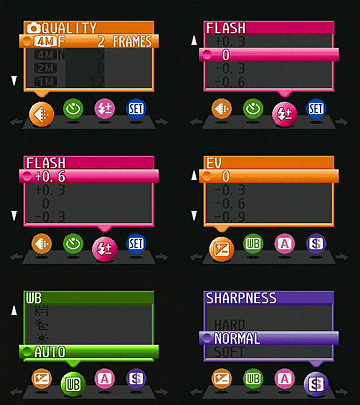 Exposure Bounty: Increases or decreases the exposure from -ii.ane to +1.5 EV in one-3rd-step increments.
 - White Residue: Adjusts the overall color balance. Choices are Machine, Daylight, Clouded, Daylight Fluorescent, Cool White Fluorescent, Warm White Fluorescent, and Incandescent.
- Aperture Priority: Places the aperture under automatic control, or offers f/ii.8, f/5, and f/eight settings.
- Sharpness: Adjusts the in-camera sharpening to Hard, Normal, or Soft.
- Quality: Sets the image resolution and quality. Choices are 4M Fine (ii,272 x 1,704), 4M Normal (2,272 x one,704), 2M (1,600 x 1,200), 1M (1,280 ten 960), and 0.3M (640 10 480). In Movie mode, options are 320 10 240 and 160 x 120 pixels.
- Self-Timer: Activates the 10-second Self-Timer mode.
- Wink Exposure Compensation: Increases or decreases flash power from -0.6 to +0.6 in i-third-step increments.
- Scene: (Scene mode only.) Places the camera into Portrait, Landscape, Sport, or Night Portrait modes.
- Choice/Prepare-Upwardly: Accesses the following Setup submenu, also as the LCD Brightness adjustment.
-
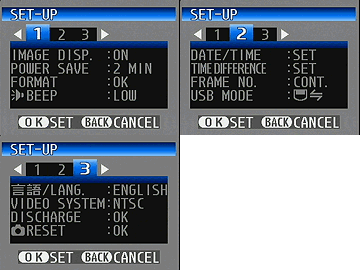 Image Display: Turns on an instant image review, which displays the paradigm immediately subsequently capture.
 - Power Save: Sets the Ability Save function to enable subsequently two or five minutes of inactivity.
- Format: Formats the xD-Motion-picture show card, erasing all files (even protected ones).
- Beep: Sets the camera'south operational beep sound to Depression or High, or turns it off.
- Date Time: Sets the camera's internal calendar and clock.
- Fourth dimension Departure: This option lets you set the time for another fourth dimension zone. For example, when traveling, you can specify the time at home and for where yous are, and the time divergence is applied to captured images.
- Frame Number: Continues frame numbering from carte to bill of fare, or Renews numbering with each new card.
- USB Fashion: Sets the USB fashion to DSC (storage class device), Web (for using the camera as a videoconferencing tool on Windows machines, or PictBridge (for connecting to a PictBridge device).
- Language: Sets the menu linguistic communication to one of half-dozen options. (English, French, German, Spanish, and ii Asian languages.)
- Video Organisation: Designates the video signal as NTSC or PAL.
- Belch: Discharges the power in the batteries, handy for avoiding "memory effect" in rechargeable cells (do non utilize for alkaline cells).
- Reset: Resets all photographic camera settings to their defaults.
-
Playback Fashion: The traditional playback symbol (a light-green arrow within a rectangular outline) designates this manner on the Power / Mode dial. Here, the user tin can review captured images, enlarge them, delete them, or set up them up for press on a DPOF-compatible output device. Pressing the Menu button pulls up the following options:
-
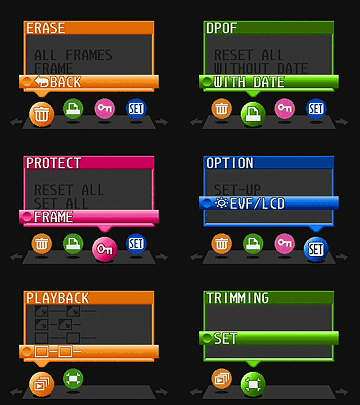 Erase: Deletes the selected frame or all frames.
 - DPOF: Marks the current frame for printing, and allows you to establish whether the date is imprinted over the image.
- Protect: Adds or removes write protection for individual frames or all frames.
- Set: Allows you to suit the LCD brightness, or pulls upwards the same Setup card as in Record mode.
- Automated Playback: Enables an automated slide show of captured images on the retentiveness card, letting you select the transition fashion and interval.
- Trimming: Lets y'all crop an image by zooming in and saving the cropped portion as a new file.
In the Box
Packaged in the box are the following items:
- Fuji FinePix S3100 digital camera
- Neck / shoulder strap
- Lens cap with strap
- 16MB xD-Moving picture Card
- USB cable
- Four AA-type alkaline batteries
- Lens adapter band
- Software CD-ROM containing USB drivers, FinePix Viewer, QuickTime, and ImageMixer VCD
- Instruction transmission and registration information
Recommended Accessories
- Big capacity xD-Moving picture Carte
- Two sets of rechargeable batteries and charger
- Ac adapter kit
Specifications
See camera specifications hither.
Picky Details
Cycle times, shutter lag, bombardment life, etc. can exist constitute here.
Sample Images
 |  |  |
| | | |
| | | |
| | | |
| | | |
| | | |



Examination Results
In keeping with my standard test policy, the comments given hither summarize merely my cardinal findings. For a full commentary on each of the test images, see the Fuji FinePix S3100's "pictures" page.
Non sure which photographic camera to buy? Let your eyes be the ultimate estimate! Visit our Comparometer(tm) to compare images from the Fuji FinePix S3100 with those from other cameras you may be considering. The proof is in the pictures, and then allow your ain optics make up one's mind which yous like best!
Demand to compare specs and features? Bank check out our "compare cameras folio," where you tin can compare all the specifications and features of the S3100 confronting other cameras you may be considering.
Equally with all Imaging Resource product tests, I encourage you to let your ain eyes be the judge of how well the camera performed. Explore the images on the Fuji S3100 pictures page, to see how the S3100's images compare to other cameras you may be considering.
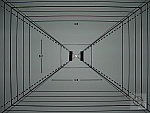
- Color: A trend toward warm colour casts, merely good accuracy and pleasing colour otherwise. Overall, color was somewhat warm with the Fuji S3100, and both the Motorcar and Daylight white balance settings typically produced like color casts. As a effect, pare tones tended to exist warm and red/orange, and the blue values appeared purplish. Indoors, the S3100's Incandescent white balance pick worked fairly well with the difficult household incandescent lighting of my Indoor Portrait test, just still left more yellow in the epitome than I'd personally prefer. In the Davebox test shot, the S3100 produced fairly accurate results, the main event being significant oversaturation of the red-hued color blocks on the MacBeth(tm) chart. Outdoors, the camera tended to overreact slightly to reds, just more often than not delivered very pleasing colors.
- Exposure: Good exposure accuracy, but high native contrast. The S3100's exposure system performed fairly well, though the high-key lighting of the "Sunlit" Portrait threw it slightly. Contrast in response to the deliberately harsh lighting there was high, and midtones slightly dark, though particular remained fairly potent in the midtones. It underexposed the outdoor house shot slightly, only it did a good job holding detail in the shadow area. I generally needed to utilize less exposure compensation with the Fuji S3100 than most cameras I test, only I'd have been happier if its images were a piddling less contrasty.
- Resolution/Sharpness: Loftier resolution, i,150 - 1,200 lines of "strong item." The S3100 performed well on the "laboratory" resolution test chart. It started showing artifacts in the test patterns at resolutions as depression every bit 600~800 lines per picture show height, in both horizontal and vertical directions. I plant "stiff detail" out to 1,150 - 1,200 lines in both directions. "Extinction" of the target patterns occurred around i,300 lines.
- Image Noise: Slightly better than average image noise. The Fuji S3100 has no ISO adjustment, so we can't talk near its loftier-ISO image noise, but at its default ISO of 100, its images more often than not testify slightly lower image noise than I'm accustomed to seeing from other 4-megapixel cameras.
- Closeups: Near average macro operation, simply good particular. Wink throttles down a little too much, is shaded slightly by the lens. The S3100 performed about average in the macro category, capturing a minimum expanse of 2.99 x 2.24 inches (76 ten 57 millimeters). Resolution was very high, and particular was strong in the dollar bill, as well as in the coins and brooch. Details softened in the corners of the frame from some lens distortion, simply were notwithstanding well-divers elsewhere. The S3100's flash throttled down a little also well for the macro area, and underexposed the shot. (Probably plan on using external lighting for your closest macro shots with the S3100.)
- Night Shots: Express low-light shooting capabilities, but good enough for typical urban center night scenes. Very limited low-light autofocus capability though. The S3100 produced clear, vivid, usable images only down to the one foot-candle (11 lux) light level. Color was warm with the Automobile white residue setting, and the warm cast increased as the exposure dims. Image noise was moderate. Its ability to capture images at 1 foot-candle would let it snap decent-looking pictures under typical city street-lighting at night, just the S3100'due south biggest low-lite limitation is its autofocus system, which can only focus well downwards to almost a two foot-candle limit. - You'll thus just exist able to expect sharp photos nether very bright outdoor lighting at night.
- Viewfinder Accuracy: A slightly tight electronic viewfinder and LCD monitor. The Fuji S3100'due south electronic "optical" viewfinder (EVF) was surprisingly tight, and showed only about 88 percent frame accuracy at both wide bending and telephoto zoom settings. The LCD monitor proved slightly more accurate, showing about xc percent frame accuracy at wide angle, and about 91 percent at telephoto. Given that I similar LCD monitors to exist as shut to 100 percent accuracy as possible, the S3100's LCD monitor has a lilliputian room for improvement here.
- Optical Distortion: Average barrel baloney, college than average pincushion though. Moderate chromatic aberration, better than average sharpness in the corners of the frame. Optical distortion on the S3100 was near average at the wide-bending end, where I measured approximately 0.eight percent barrel distortion. The telephoto end fared only slightly meliorate, as I measured approximately 0.six percent pincushion baloney. (That's a fairly big amount of pincushion, simply not unusual for a long-zoom lens.) Chromatic abnormality was moderate, showing about four or five pixels of coloration on either side of the target lines, visible at both wide angle and telephoto focal lengths. (This distortion is visible every bit a very slight colored fringe around the objects at the edges of the field of view on the resolution target.) The S3100 did practice a bit better than average job of maintaining sharpness in the corners of its images, something a lot of digicam lenses have difficulty with.
- Shutter Lag and Bike Time: Skillful to slightly slow shutter lag, average cycle times. With shutter lag that ranged from 0.68 to one.11 2d, the Fuji S3100 spanned the range from faster than average to a flake slower than boilerplate. - But it did pretty well when compared with other long-zoom digicam models. Prefocus lag was 0.12 second, a very good number. Shot to shot times were average, at 2.2 seconds/shot for big/fine images. (All shots happened that fast though, at that place was no delay after a buffer memory filled.) The S3100 has no continuous shooting mode.
- Battery Life: Really excellent bombardment life. With a worst-case run time of four.3 hours with "standard" 1600 mAh NiMH cells, and a run time of over 8 hours in playback fashion, the Fuji S3100'south battery life is much amend than average. I still recommend that you purchase a good set of high-capacity NiMH batteries and a good-quality charger, but the S3100 does much better than average in the battery life department.
Decision
| Free Photo Lessons |
| |

Other Reviews
- User reviews for the Fujifilm FinePix S3100 on PC PhotoREVIEW
Source: https://www.imaging-resource.com/PRODS/S3100/S31A.HTM

Post a Comment for "Fujifilm Finepix S9100 Digital Camera Action Shots Review"